
Qwen3.5-9B or Ministral-3-14B-Instruct-2512: how much difference does the local AI model really make?
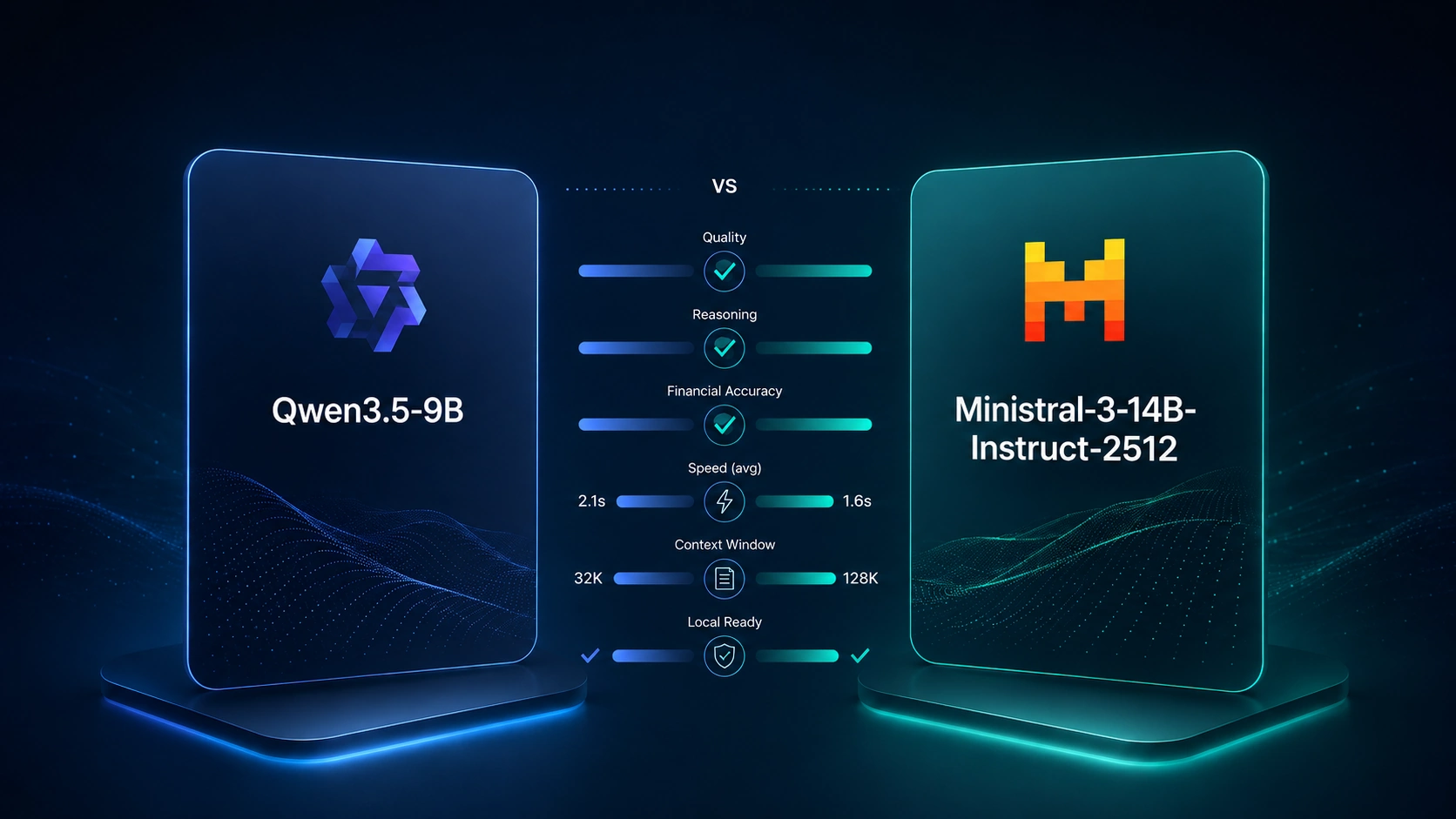
My Wealth 1.6 offers several local artificial intelligence models to suit the resources of each computer. Qwen3.5-9B has 9 billion parameters, while Ministral-3-14B-Instruct-2512 has 14 billion.
On paper, Ministral has greater capacity. In practice, our tests reveal a more interesting picture: the larger model succeeds more often on complex requests, but is not always better. A lighter model can be more direct, faster and sometimes more faithful to the structured information supplied to it.
This comparison is therefore not intended to crown an absolute winner. It helps us understand how each model reasons and improve the assistant for every profile.
How do we evaluate the models?
We use a reproducible test portfolio and questions phrased as they might be in the application. The scenarios cover:
- portfolio value and composition;
- allocation and concentration;
- liabilities and the assets they finance;
- passive income;
- budgets and recurring operations;
- investment goals and projections;
- requests requiring several sources to be cross-referenced;
- preparation of modification operations while respecting permissions.
Each test examines several stages. The model must understand the request, select the right MCP tools, prepare their parameters, use the results and write an answer consistent with the data. We also check that it does not invent values or propose an operation that was not requested.
Failures are classified by their first cause: wrong tool, invented parameter, incorrect business value, insufficiently grounded answer or execution problem. A correction is added only when the traces demonstrate that it is necessary.
Results in figures
For a fair comparison, Qwen3.5-9B and Ministral-3-14B-Instruct-2512 received the same 46 questions about the same reference portfolio, with access to the same tools. These are the latest available runs:
| Result across the 46 common scenarios | Qwen3.5-9B | Ministral-3-14B-Instruct-2512 |
|---|---|---|
| Passed tests | 33 / 46 — 71.7% | 37 / 46 — 80.4% |
| Failed tests | 13 / 46 — 28.3% | 9 / 46 — 19.6% |
| Observed median duration | 2 min 52 sec | 3 min 44 sec |
These figures are a development snapshot, not a universal benchmark. Tests ran on a computer with an Intel Core Ultra 7 165U, its integrated Intel graphics and 18 GB of shared memory. This is not a workstation designed for local LLMs: it has neither a dedicated graphics card nor dedicated video memory. Even so, Qwen3.5-9B answers within a few minutes and handles some common questions in just over a minute.
In practice, both models used the Compute part of the Intel GPU. With Ministral, Vulkan may report a fallback presented as CPU execution, although resource monitoring shows that the CPU remains idle during inference and the GPU carries the load. The tests also accompanied several successive orchestrator improvements, so the timings do not isolate model architecture alone.
In this campaign, Ministral completed more scenarios successfully, while Qwen remained noticeably faster. The larger model improves some complex requests at the cost of more resources and generally longer processing times.
Where Ministral has the advantage
Ministral was more comfortable when a request required several pieces of information to be linked before answering, including:
- comparisons between owners;
- an asset family’s value compared with debt;
- the share of income generated by financial assets;
- identifying high-value but low-yield assets;
- matching financed assets with associated liabilities;
- recurring investments configured in budgets;
- goals furthest from their target.
This fits its intended use: richer comparisons, relationships between several entities and requests involving more steps.
Where Qwen surprises us
Qwen is more than a lighter alternative. Its behaviour is often more direct. When a clear summary or canonical result already answers a question, it tends to return it without unnecessary reinterpretation.
A recent batch used the four default questions in the AI panel:
- What is the situation of my wealth portfolio?
- Where is my wealth most concentrated?
- Which asset has the best performance?
- How much of my wealth can I access quickly?
Qwen passed all four. Ministral passed three in its first complete run, but omitted the highest concentration in the second answer even though the data was available. It had selected the correct MCP analysis; the error came from how it reinterpreted the returned dimensions.
This captures an important lesson: deeper reasoning can solve a complex request, but can also cause a model to reclassify or enrich an answer that should remain strictly faithful to an already calculated result.
The model does not work alone
Assistant quality does not depend solely on the LLM’s parameter count. My Wealth adds an orchestration layer between the question and portfolio data. It:
- presents a compact catalogue of available tools;
- lets the model select useful tools and prepare their parameters;
- validates calls before execution;
- returns structured errors when a plan can be corrected;
- calculates certain canonical relationships from MCP results;
- keeps the model responsible for understanding the request and writing the answer.
The aim is not to replace model intelligence with predefined answers. The LLM interprets and explains, while the application secures access and stabilises exact facts that must not depend on linguistic approximation.
Our tests also show that both models do not always benefit from the same instructions. A prompt effective for Qwen may be ignored or overinterpreted by Ministral, and vice versa. My Wealth therefore applies model-specific policies instead of relying on one universal prompt.
Which profile should you choose?
Qwen remains the best starting point for everyday questions, portfolio summaries and computers with more limited resources. Its speed and direct behaviour already handle many useful requests correctly.
Ministral becomes valuable when you query several dimensions at once, compare entities or request an analysis involving more steps. It does not guarantee a perfect answer and may take longer, particularly without GPU acceleration.
The right choice depends on the questions you ask, the resources available on your computer and the response time you consider acceptable.
Evaluation continues after release
The release of My Wealth 1.6 does not end this campaign. Every reproducible error may expose ambiguity in a tool, an insufficiently explicit business relationship or model-specific behaviour.
These lessons improve the orchestrator, MCP contracts and model policies without hiding their limitations. They will also guide the integration of future LLMs offering a better balance between quality, speed and required resources.
Like any artificial intelligence, the assistant can still be wrong. Important financial information should always be verified, regardless of the selected profile.